

To live in a tent for a long term! Sounds like a dream most of us had growing up. Imagine being surrounded by wilderness while stargazing or sipping cappuccinos sitting before a bonfire! Very few scenarios are as dreamy as it.
But regardless of all the romanticization associated with tent living, permanent tent living can be quite daunting. Just think about all the bugs and atrocities you may have to deal with daily. So, whether you’re contemplating a tent vacation or a longer escapade, read on to know what you should keep in mind for a homely, cost-effective, and divine tent life.
How to live in a tent for a long term: Your ultimate guide
Well, that sounds a bit extreme. But does it actually? Everything that we know to be norms is nothing but societal constructs. Why can’t you be camping year-round if you can survive? Whether you want to reject modern society or looking for a long-term adventure to enrich your experience, camping is always a great idea.
I feel that we human beings belong in nature. Being surrounded by all these concrete elements can sometimes wear us down. No, I am not downplaying the comfort that modern life has blessed us with. But sometimes I wish that we could have the best of both worlds. So, if you’re contemplating deep healing, I love that journey for you!
Nevertheless, if you think you can figure out everything as you go about your way, that’d be a mistake. Even though living in a tent is not impossible, it’s not easy either. So, what’s the solution? You must do your research, figure out the right equipment and stay on your guard for any adverse situation.
And to help you with that, we’ve come up with this article. So, stay tuned.
Live in a tent for a long term: Choosing a quality tent
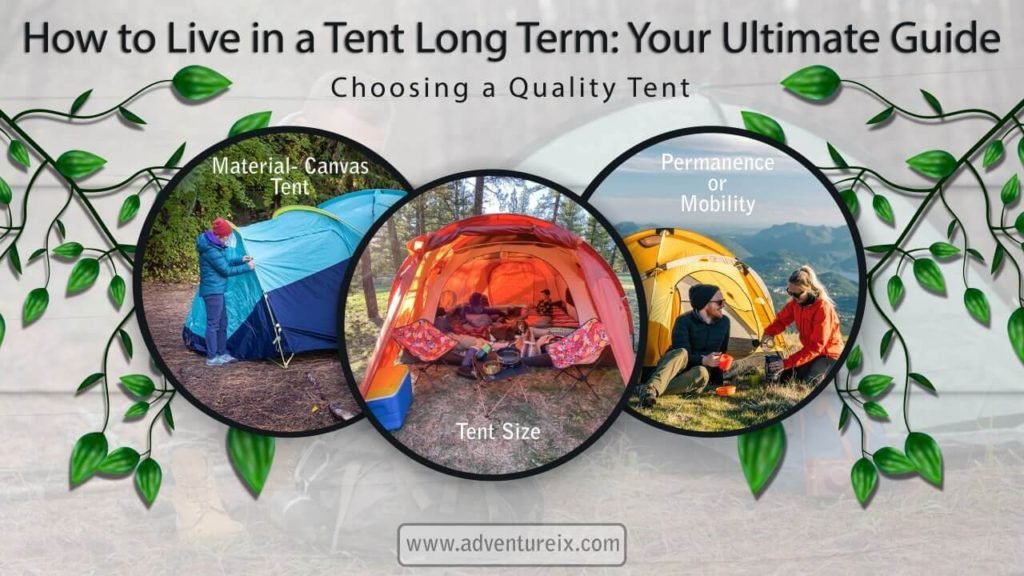
Canvas tent
Laying your hands on the right tent is the first and foremost thing you should be concerned about. And good things come at a price. If a pricey tent is cost-effective, don’t hesitate to splurge. Now, how do you know which tent is worthwhile? Well, the answer is always a canvas tent.
Even though they’re more expensive than other types of tents available in the market, they’re quite cost-efficient. They’re pretty long-lasting and completely on par with your year-round adventure. Besides, unlike a nylon tent, a canvas tent doesn’t trap moisture within the material. So, it’ll not stink.
It’s also more suitable if you plan to make an abode in a warmer region. Its breathable quality makes way for better ventilation and lets you soak in the fresh breeze. Nevertheless, all these good qualities weigh in on a canvas tent- quite literally. That’s to say, a canvas tent is heavier than other types of tents.
Also, while canvas tents are durable and more breathable, they’re not easy to upkeep. Nylon tents win the race when it comes to maintenance. Because of their lightweight, you can easily clean them. If you camp in hilly areas you might want the best camping tent for high winds.
Size
Now that you’ve chosen your tent material, you must think about the size. When it comes to long-term tent living, tent size matters. Since you’re thinking about a longer stay, you need to purchase a spacious tent to live comfortably and make room for your essentials.
So, do not go to a camp for 2-person. Rather, a camp designed for 4-person is what will get you settled. Depending on the number of members, the size could be even bigger. If you’re in the mood for something fancier, you may purchase a tent camp as huge as an outdoor house. Those will let you keep the rooms separate.
Different tents also come with solid walls. That way, you can have the best of both worlds- modern amenities and wilderness. As alluring as a tent life sounds, it’s not everyone’s cup of tea. So, why squander money over something that might not work for you long term?
If you want to start a bit more calculative or experimental, you could even start with a rented tent.
Permanence/Mobility
This is another crucial criterion you must consider while choosing a tent. You need to determine whether you’re going to camp in the same place year-round or you’re going to keep moving and exploring. Lightweight nylon that provides adequate shelter will be a flexible option if you plan to move around.
Usually, people opt for pop-up tents if they move around a lot. These tents can be set up quite easily. Once you need to relocate, simply disassemble the tent and pack it in.
Live in a tent for a long term: Choosing the location
Now that you know which tent would be cozy and comfy figure out where you’d like to start your camping journey. Besides fresh water? On a hilly ground? In a wild forest or where? Of course, the location must be serene. But only great outdoors won’t ensure your sustenance. You need to be mindful of so many other things!
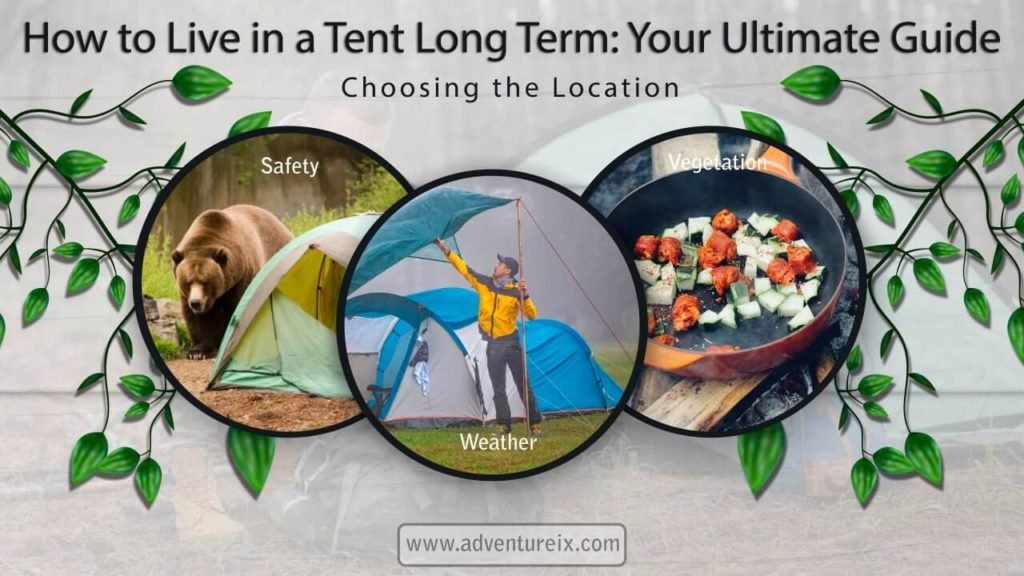
Safety:
If you’re finding shelter, make sure that the space is secure enough. You don’t want wild animals to feast on you. So, make sure that you’re not pinning down a place that’s the abode of ferocious animals.
Law & Order:
Not every land in every region can be regarded as a free campsite. You don’t wanna break any law unknowingly and then get in trouble. You can talk to fellow campers regarding suitable locations. Also, you might not be the only one camping in one location.
Try to gather information early on about your prospective neighbors, whether they have any history of troublemaking. Go and check out the place. Avoid camping in the said location if you think other campers are associated with unlawful activities.
Weather:
Weather plays a more important role than you apprehend right now. Most of your comfort will come from the atmosphere of the place. If you’re not on par with it, you won’t be able to relish the beauty of simple life. So, ask yourself whether you thrive in warmer climates or on the cold ground. Then, choose your location accordingly.
If you’re going for a warmer region, make sure a well-functioning fan accompanies you. During cold nights you will need to how to insulate tent for summer or winter. But if you choose to settle in a colder tent site, pack your heater and a thick blanket.
Vegetation:
Since you’re going far from the madding crowd, you won’t have the luxury of going grocery shopping whenever you run out of supplies. So, yes, you must stock your food wisely, but there’s no harm in habituating to a place with an abundance of fresh fruits and vegetables! That’s a must to get the real taste of organic life.
Live in a tent for a long term: Bare essentials
You can escape modern life, but not modern technology. Even for a short time, you must take essentials. How can you live year-round without them? So, bring all camping stuff so you don’t feel rushed. What’s absolutely vital?
For starters, some people prefer not to detach themselves completely from modern amenities on the first go. So, they set up solar panels in the tent site. Gradually, you may minimize the need for energy. But let yourself settle in with ease.
So, get yourself an adequate source of artificial light and all the equipment to keep you entertained in the initial stage. Store your phone, tablet, and of course, power bank. Yes, we know you want to experience organic living. But one thing at a time.

The supply of fresh water is another thing you must be concerned about. You must bring in a propane heater to make sure that you can boil the water for drinking as well as cleaning up. Other than that, stock as much food as possible. But make sure that they have a great shelf-life. So, pack yourself bags of dried munchies. If you can arrange a cutesy freezer, you may also aim for frozen goodies. You will need to learn how to keep food cold while camping.
Next, you must set up a wood stove. A camping stove will help you cook your food inside. Your protected stomach can’t absorb raw food, no matter how immune you are. If you don’t mind being poisoned, don’t pull a Bear Grills.
A sleeping bag is another tenting requirement. It’ll be helpful for winter camping. A sleeping bag might help you sleep in less space. Temperature is vital for coziness. So bring a heater for the cooler months and a fan for the hot months. Leave a small carbon footprint.
How to live in a tent for a long term: Getting started
Deal with proper authorities
Start looking for proper channels to find your perfect setting. You can also talk to US national park authorities or look for rented land. Or make a deal with a local farmer. If you stay on private land, you won’t worry about trespassers. As a cherry on top, you can gather hands-on farming experience and cultivate your own food.

Apart from that, you may opt for free campsites. Such a site comes with different facilities like a cleared-out and flat ground, making the setup process even easier. Most importantly, they even have communal toilet facilities and a fire pit. But if you decide to go solo and independent, you have to arrange everything on your own, which can be a bit of a drag sometimes.
Mock-tenting
A mock test is a good way to learn whether you’re prepared for an examination or not. So, why camping be any different as you set out for a life-altering journey?
A mock-tenting would make you feel confident regarding your camping preparation. So, if you can start off tenting on the spare ground or yard of a friend or family member. Make sure to restrain yourself and use as few modern facilities as possible.
How to live in a tent for a long term: Set up
This is your first step towards officially rejecting modern society. Start off your tent life by setting up a raised tent pad with the owner’s permission. It’ll ensure your tent stays dry and clean.
Don’t set up the tent on the rocky or sloppy ground. Try to set up your tent facing south. It’ll make way for maximum ventilation and sunlight. Make sure to check the weather updates beforehand. Setting up a camp during the rain is more challenging and less romantic than mainstream media portrays it. Especially if you’re camping alone.
For those planning to camp in groups, half of you should be setting up the tent, and half of you should unpack all the camping gear so that they don’t get soaked in the rain. Regardless of how many members are camping, follow these helpful tips to master how to tent camp:
- Tether the corners of your tent and then stretch out guy ropes properly. It’ll hold everything in place.
- Now join all the tie-outs of the rain fly. Elevate them; that way, those will be settled nicely over time by stretching. You may also tie them off with a tree branch.
- Make sure each pole is secured with its corresponding hook. The hook should be located at the top center of each side panel.
Arranging your stuff to live in a tent for a long term:
The primary and harder part is done and dusted. Now, let the tent life begin. Beautify your new abode in your own style.
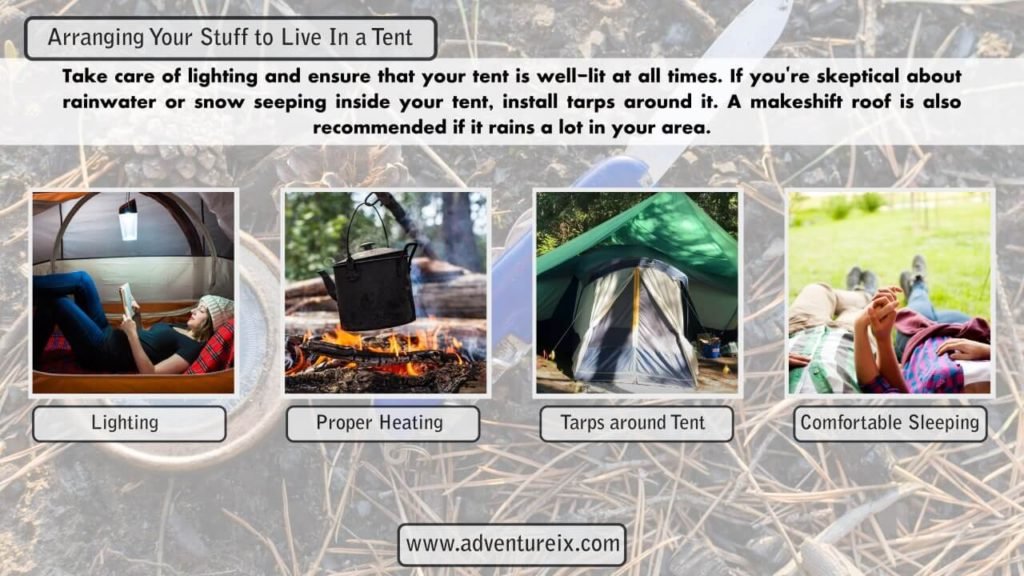
Lighting
Take care of lighting as it’s an absolute necessity. Don’t rely on fire or candles, for it may cause mishaps. You can set up solar panels or a generator if you may. In cases of outages, you should be counting on torch lights. So, stock up as many batteries as possible.
Never keep your lights or other essentials beside tent walls, for they may get stolen or misplaced by you while in a rush. Without lights, you’d be practically blind at night, for our sight is useless in complete darkness.
Heat
Next, you must arrange proper heating options. Mother nature can be pretty extreme. We can barely go without a heater in our house when it’s winter. And during the hot weather, an AC becomes just another essential. So, get yourself a propane heater or wood stove to keep yourself warm and nice.
The latter one is better as you won’t have to refill any tank. Besides, wood is easily accessible, and it’ll help you make the best of organic living. You can cook mouthwatering food on this stove as well.
Tarps
Now that your tent is well-lit and has a nice balanced temperature, you must ensure dryness. If you’re skeptical about rainwater or snow seeping inside your tent, install tarps around the tent. A makeshift roof is also recommended if it rains a lot in your area.
Sleeping arrangement
The things mentioned above cannot boost your serotonin level if you’re sleep deprived. Sleeping in a bare space is never recommended. It’ll make you catch a cold, especially in colder months. So, spread out a sleeping pad or a soft and thick mattress. You can further ensure that no water seeps into your bedding by insulating the space.
Managing space
Okay, now let’s talk about actual beautification. Even in the most gigantic tents, you may not find enough space to accommodate everything unless your way of living is extremely minimal. So, what to do?
- Get yourself a high rising bunk bed, and you can keep a lot of cooking equipment and other belongings under the bed.
- Make use of hanging storage. You may hang different things on trees or poles. But would that be safe? Well, you have to figure it out on your own.
- Only use foldable furniture and keep it away unless you’re using it.
Hygiene
Maintaining a hygienic life may consume a lot of your energy if you live in a tent. But you must not go easy on it for your own sake. So, brush your teeth regularly. Physical labor may make you sweat more than usual. Only using a deodorant is not the solution. Bathe every day in a nearby waterbody.
Also, wash your clothes regularly. You need to have a large bucket for that. Airdry them properly by hanging them on a wire. Maintain minimum 200 feet (61 meters) distance between your tent and the toilet. The hole should be at least 6-8 inches (15-20 cm) deep. Fill it in with soil as soon as you’re done.
Live in a tent for a long term: Challenges
There are certain challenges to be mindful of if you’ll be living in a tent for the long term:
- Running water won’t be an option anymore.
- You have to make the best of limited space.
- Access to power will be limited.
- Privacy will be a myth.
- You can no longer avail a proper bathroom.
- You must adjust to rapid weather changes.
Frequently Asked Question(FAQs)
How long can you live out of a tent?
Using a single tent such as a wall tent, you could live out of it for a few years, but only if you take care of it properly.
Can you live in a tent during winter?
Yes, but only with a durable and insulated tent that is also waterproof.
How long does a camping tent last?
In general, a tent is supposed to last for upwards of a decade for a long time. But some tents don’t last long.
Conclusion
So, do we think you’ll be able to cope with these problems? We wish you all the best and keep our thorough guide if you do. We’ll be honored to be of your help. Happy camping!